Showing posts with label texas chainsaw massacre. Show all posts

Monday, June 3, 2013

The Last Laugh

The last chapter of The Funhouse Blog's scene by scene analysis has been hard to write because this has been such a pleasure I haven't wanted to end. Here we are though, down to picking apart the final few minutes, so let's conclude.


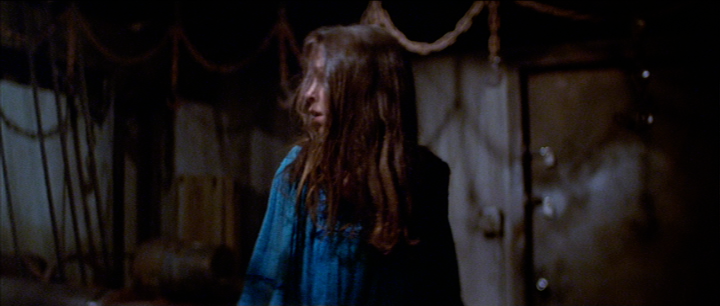
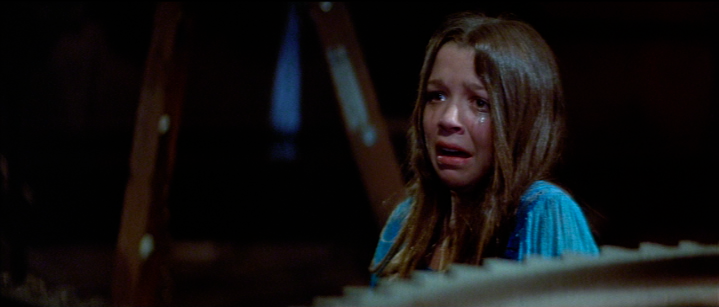
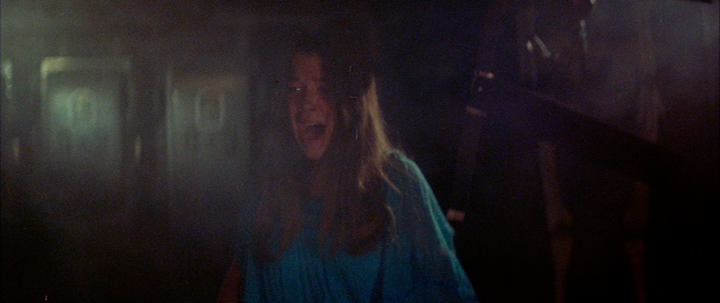
Amy's scream of horror could have ended the film already, just snap black to credits in the throes of The Monster's agonies. To end a horror film at the apex of excitement has been a frequent technique in Hooper's filmography since Leatherface thrashed his chainsaw about in the last shot of The Texas Chainsaw Massacre. Instead here he gives us a magisterial eerie coda uncommon for the nominal slasher film.


Amy's exit out the wrecked doors is handled deceptively as matter-of-fact, as if the near silence of faintly howling morning wind will be pierced by the shout of concerned carnies, or approaching police, or maybe even mom and dad.


[LAUGHTER]


As a non-living but animated character, the Fat Lady doll has been focused upon at several crucial tonal points throughout the film: first as an avatar for director Hooper, then in dissolve upon Tad the mutant fetus, and the last time was an encounter by the easily spooked Joey. She is the twisted soul of the carnival, the bloat and ugliness of life painted into grotesquerie prompting us to laugh at the shamefulness of our bodies. Irony is the glory of slaves, though, and the insufficiency of this clowning's therapeutic qualities in preparing anyone for real death and/or sex has been the subtext of the tale.


[GASPS]


[LAUGHING]

The Fat Lady's canned hoots and hollers are now heard isolated from last night's carnival racket and the message of mockery is direct to Amy alone. Despite not even being alive, this mechanical character we (and to her visible horror, Amy) project a character upon is the only character to emerge the fateful night unscathed, and her message to Amy is as they say about casinos: the house always wins.


The uncanny creepiness of the moment is compounded by the game Hooper has been clandestinely playing with old childhood feelings towards dolls since Joey made his ventriloquist dummy's head wink at the camera in the opening scene; conditioning us to accept the titular funhouse and its puppet denizens as "alive", so effective is their gonzo simulacra of trap doors, lighting flashes and sound effects, including an ever-rolling chorus of incongruous laughter.

As with Joey's sighting of the Fat Lady's errant arm movement, there's no real reason for the doll to be spontaneously jerking to life. With the addition of the laughter, this is the "final scare" of The Funhouse in terms of a slasher film's beats wherein the killer thought dead surprises us one last time. Except in this case the killer is an institution, The Monster's home which is standing in for the institution of horror films. As Bruce Kawin noted, the "overweight, chuckling doll" is Hooper's surrogate and "the last laugh" is his. Elizabeth Berridge really captures the spiritual desolation of Amy in her reactions.


A more cynical or less sensitive filmmaker than Hooper could've easily had Amy crack up in the face of the Fat Lady's guffaws, perhaps with a slow giggling that gradually rose in pitch until their voices are joined in a chorus of madness...snap black to credits. A really superb predecessor of sorts to The Funhouse, Tourist Trap (1979, David Schmoeller) had an ending like this after exposing its Final Girl to an excess of puppetry. Abruptly ending a horror picture on the heroine's fractured sanity after one final terrifying indignity is usually always ascribed (or blamed) on Carrie (1976) but Tobe Hooper predates De Palma with Marilyn Burns' shrieks of relief that reverberate with shattered sanity. The film is concluding gracefully rather than forcefully, reinforcing the classical structure of the overall piece and giving us the literary equivalent of an epilogue.


[LAUGHTER SLOWS AND STOPS]


When the laughter dies, John Beal's pensive wind instruments pick up, announcing the full circle is complete: the flute lick that began the film is signaling the end of Amy's, and our journey.

In short succession, Amy walks by some creatures of the carnival with special symbolic significance to where the night's terrors have left her. Barely visible in the background is Carmela and her dad Marko the Magnificent, the sole healthy parent/child relationship in the film, which says an awful lot.


Carmela is under her father's wing, and this familial closeness placed at the opposite end of Amy subliminally reminds that homecoming will never be as it once was. Halloween ends with teenage Laurie Strode weeping to a gun-toting b-movie psychiatrist and imitators like Friday the 13th with Final Girls babbling to bad actor cops. Lingering on Amy in silence, one gets the sense that grateful as she may be for survival, she'd like nothing more than for the world to turn back a day and return her to the world of childish innocence and ignorance.


 BAG LADY: "God is watching you..."


Amy receives denouement from The Bag Lady, someone we surely thought we'd seen and heard the last of. Her reiterated warning at this time is kind of cruel, basically an "I told you so" for irony's sake from Hooper. The timing is so good you can't help laugh a little, indeed there were a couple nervous chuckles from the crowd both times I've seen The Funhouse in a theater. The fact that Amy is already sobbing from this psychic whupping with tail between her legs is a particularly sad detail.


Regardless, Hooper's rapidly distancing crane shot and the self-conscious quality of letting the film's doomsayer get the last word reminds us that this is, after all, "only a movie" and one that hasn't allowed its audience the comfort of genre cliches being rapidly codified by 1981's massive influx of slasher film product.


The last fairgrounds straggler to cross Amy's path is also the most marginal: the nameless raggedy man credited only as "Geek" who was the first person Amy's path crossed upon entering the carnival. Just before she and the group walk past him he's ignored by a mother and her young daughter, and Amy's bunch pays him even less attention, as it so often is for the destitute and visibly broken. Amy now walks among his ranks.


He even reaches out to her like a kindred wounded soul, and is ignored again. In conjunction with the crane shot, Amy is blending in among the refuse and dirt.


Unlike screaming Sally from Texas Chainsaw or so many other Final Girls, we're given breathing room to ponder Amy's life beyond the film as her long walk home commences. This is helped too by the placement of her exit from the funhouse at daybreak, the restoration of external normality, something considered rather old hat by the time The Funhouse was made.


In spite of what I said before, there's a strong cynicism to it, just a quiet kind - Amy's future is mundanely easy to imagine and not all that bright. Innocence lost, Amy Harper will return to the ordinary life she was living 90 minutes ago in movie time with a newfound sense of the world's darkness that will either more likely cripple than toughen against it.


She may become a nun, she may become a mom, she may become a drug addict. A nurturing home, as we know, does not exist to come home to, so what happens when Mr. Harper greets his little girl at the front door? What about the anguish they'll feel upon realizing they nearly could've saved her during the same trip to the carnival that recovered Joey?


My first exposure to The Funhouse was actually flipping past it watching TV on a weekend afternoon, on the then-horror heavy Sci-Fi Channel of the mid-to-late 90s. Something about everything was immediately terrifying to me and yet I was inexorably drawn to it because I kept flipping channels back, watching for as long as I could before it became too scary. In my mind, the fragments became a version of the horror wherein the funhouse really was alive and was inexplicably inhabited by a lurking monster as well.


The last time I flipped back was this tracking shot, which at this point is hovering above Elizabeth Berridge at an altitude where if you had just started watching, you might not know she's the focal point. As a kid, I thought this ending was a gaze out upon the carnival after the girl who was running through the funhouse and then being stalked in a chain-filled room by a monster must have met her inevitable death.


On some level the version in my imagination was always scarier and discovering the more mundane truth of the story was a disappointment. On later viewings there was still something that made the film sit ill at ease in my stomach, and eventually I realized it was precisely the low key nature of the story, the slow burn leading up to that monster who's really just a freak. Impossible (yet rickety-looking) funhouse aside, it's all more plausible than Halloween or Friday the 13th. Combined with the texture - the sight and sound of this bright and grimy world of Hooper's which made the frightening impact it did on first contact - my fascination with the film grew.


A few years later I found Bruce Kawin's essay on the film (and Joe Dante's The Howling) in Film Quarterly of 1981, reprinted in the book American Horrors: Essays on the Modern American Horror Film, which I've quoted extensively throughout this analyses. His great insight was that this was partially a horror film about our attitudes toward horror films but more broadly, our categorizing horror images as entertainment, whether at a movie or at a carnival.


What really made me want to attempt this analysis was a book on They Live by Jonathan Letham, part of a series of film analyses by literary authors called Deep Focus - "A Novel Approach to Cinema" published by Soft Skull Press. The meticulousness appealed to me and although The Funhouse did not contain as many cultural and political layers to delve into as the John Carpenter film, its artistry and character seemed equally worthy of a longer look. Moreover, a blog could contain the most thorough scenic dissection possible outside of the 24 hour slow-motion version of Psycho screened at the Museum of Modern Art in New York.


Julius Banzon, who blogs about Tobe Hooper exclusively at The Tobe Hooper Appreciation Society, has indispensably added his words and continued inspiration during this project through discussions of the film and Hooper in general.


I like the way The Funhouse ends; we're able to catch our breaths and even begin mulling over the entirety of the picture, with a Godlike view of all the pieces.


In our distance, and the slow fade, we watch ourselves watching.

Sunday, May 5, 2013

Amy vs. The Monster


[CHAINS CLINKING]


[MONSTER GROWLING]


JR:

The Funhouse's climax grinds the terror to a halt in order to become an inhuman, clockwork mechanism itself, all starting with the desolate clatter of Amy's heels being lost to gravity (a constitutive divestment given sobering emphasis by the film, a moment of muted transformation - of both film and heroine - and a sick, hardhearted dolefulness that never fails to hit me like a cold splash of water, in response to how quickly on a dime the film reveals its severe utmost machinations.


JR:

Grinding everything to a halt, including all affect and cinematic pretense, this sequence of Amy's immediate entrance into the machinery room is methodical - devoted to transmuting the threat from the realm of slobbering Monster to the realm of Ideas; the intelligible, highest truths.  It goes about this not only by suddenly draining out all "activeness" and spontaneity from cinema (in frankness, it's not like The Funhouse hasn't already been constantly using slowness as a trope, during everything from the dog scare to Liz waking up in the vent), but in so suddenly deeming the terror inanimate, and particularly at an apogee of inanimateness.


[STEAM HISSING]

Not even in the realm of the humanoid stand-ins that are the funhouse puppets, the terror now quite literally becomes simply a hanging grate (spinning in a mindless to-and-fro motion that is the definition of the uncanny and the indifferent), or jets of steam that shoot haphazardly.


[MACHINERY MOVING]

The basement of the funhouse in The Funhouse is one of Hooper's great "terrible places" (per Carol J. Clover) which typically happens to be subterranean, as in 'Salem's Lot or Texas Chainsaw Massacre Part 2 or Invaders From Mars. Befitting the visuals, the events grind to a halt. This handbrake to the film's pacing is complimented by the incessant push and pull of gears surrounding Amy on every plane of sight, and John Beal's soundtrack also abruptly drops out, replaced on the soundtrack by the monotonous rattling of chains and turning gears for several minutes. Stripped of its hide, the belly of the beast is a stark contrast to the peacock plumage upstairs, all rusted metal and steel. Only the impersonal brutality remains. For a horror film about imprisonment in a phony horror world, this is a more understated "Man behind the curtain." I've always thought of it as representing the hidden, ugly soul of the funhouse's newly dead owner The Barker - still chugging along "alive" without him.


The wide shot establishes itself as responsible for finding perfect pictorial moments of Amy placed in the environment, either flattened by foreground elements or herself in the foreground engulfed by this most disconsolate place imaginable.


A small emotional hobgoblin has burrowed up as Amy tries unsuccessfully to find her way out: if she's out of the funhouse, shouldn't she be out of danger? Yet this is the end of the line, the real end of the line for Amy from which Buzz only won her a temporary reprieve in the previous sequence.


 LIZ: [CRIES]

And as she flees our intractable camera-gaze - but what is really our companionship - towards possible escapes, Hooper cuts to tight shots of Amy in that separated space.  She is caught in an inescapable pattern, brought to bear when the shot cycle starts anew.


The POV shots are dynamic spatial emphases on the cold implacability of the room's mechanisms, from any angle.


Of particular interest here to horror fans should be Hooper's excellent rendering of industrial space as an implacable nightmare. In The Texas Chainsaw Massacre this feeling is implicitly suggested by the exposition of Leatherface's family being slaughterhouse workers - actually telegraphed first when Franklin describes the factory floor environ and the "big air guns," horrifying the organic tastes of his hippie travel companions. To reactions to disgust at the meat-worker's delicacy of headcheese, he simply remarks "Oh, you'd probably like it if you didn't know what was in it." So too the funhouse: you might like the idea of working at one if you weren't thinking about the limb ripping machinery under the floorboards requiring constant maintenance. Hooper wouldn't make death by industrialism the explicit subject of a horror film until 1995's The Mangler but in Chainsaw and Funhouse the fascination is clearly there.


An especially sinister detail of this discomforting environ, borderline surreal, is the series of dangling hooks on chains, moving through the room like grinding teeth. Hellraiser would more famously exploit the chain-link torture chamber aesthetic about five years later.


The second cycle that occurs has Amy awkwardly making her way underneath a system of belts, rump in the air.


[GRATE BANGS]


LIZ: [CRIES]


I've been using words that suggest a conflicting experience: both words that intone cruelness on the film's part - "hardhearted," "machinations," "inhuman" - as well as words that suggest a high capacity for empathy - the camera as "company" to Amy.  This is intended, as this section's grip on its intentions is as implacable and cold as its setting.  But when I mentioned the film's awareness of the "transformations," this included Amy, whose transformation is one made through tough love: only by being thrown into the chaos can Amy be the principal subject of the film's centerpiece editorial - an exposé.


Slowly, almost imperceptibly, John Beal's music creeps back under Amy's actions and builds up a chained melody to crescendo on an image of gears which evokes nothing less than youth staring down the business end of a meat grinder (the Texas Chainsaw connection again) or the business of show business.


The scene is cruel but simultaneously exhibits a great generosity: a reprieve to both Amy and the Monster, as it transplants the fear from the Monster to the inanimate fears (also known as "vast" fears), which is both fear of the unknown and very existent fears, of conditions, social and otherwise; and to Amy, the scene revolves around her realization of the space, and builds up to no greater a point of understanding than can be provided for her, this being the concluding shot of this internal mini-sequence: Amy staring down into the gears turning before her later in the scene.


Essentially the pinnacle of the film for me: Amy stares downward into the teeth of the turning gears and the camera sets into a slow crawl that pushes towards her.


 [THUDDING SOUND]


[GRATE BANGS ONTO FLOOR]


 [STEAM SHOOTING]


One of Hooper's pet themes is the idea of the threat off screen, not necessarily there, and fear as an entity in and of itself more present than the actual monster that exists.  No one films a person creeping around in psychological terror like Hooper - just think Susan in the Marsten House, Stretch in the hallways of K-OKLA, or Colonel Carlsen in the dead of night, wherein the camera jump to positions - uninhabited - moments before these characters jerk their heads in that direction with an imagined fear.

JR's comparison of this room and mood to the Marsten House from 'Salem's Lot is apt: Hooper used the same production designer on both films, Morton Rabinowitz. In both cases he excels at constructing claustrophic, lived-in tombs of stone gray dread.


[LADDER THUDS ONTO GROUND]

AMY: [SCREAMS]


MONSTER: [GROWLS]


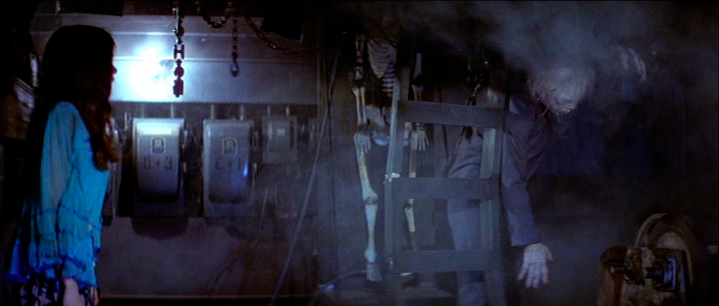
The film allows The Monster a kind of totemic beat of glory here, rising up into frame as he does while Amy stands stupefied with mouth agape. This and the flickering light through the fan during Liz's death suggest to me that Hooper is riffing again on the energy of Alien, because this brief face-to-face is most immediately comparable to Harry Dean Stanton's frozen awe when the alien rises before him. Even the chains are an identical visual cue in both scenes.


[MONSTER: SHRIEKING]


The evocation of petrification isn't entirely successful, however. Both times I've seen the film with a crowd there's been some awkward laughter because The Monster just stands there yowling, seemingly wanting Amy to make the first move. This isn't too crazy an interpretation; if we know anything about The Monster it's his fear/anger around women. Given the chance to pounce on her in the last scene, his intention seemed more just to frighten her, and then there's his lack of malice towards Liz. right now, Amy isn't just the only woman in his life, she's the only other person still alive in the funhouse. The feeling within his extended cry is less likely rage than feelings of exasperation and despair similar to Amy's: "Why did you have to be here tonight?" The Monster is murderous but thrust circumstantially into this role of ultimate killer, the whole point of his character is that he needed a little love in a sleazy world. A pertinent piece of information revealed on the Scream! Factory Blu-Ray / DVD release commentary track with Hooper was that The Monster is meant to be around 18, a teenager like Amy, which supports the romantic read of this scene for romantic variation on a Final Girl's confrontation. The Barker was scarier when fighting Buzz. Amy's brief skirmish is more balletic and in a grim way, comical.


 AMY: [CRYING]


Amazingly, The Funhouse reverts to indisputable slasher formula the moment that crowbar falls to Amy's hands. Hooper's drive-in damsel in distress Marilyn Burns never wielded any phallic symbols against Leatherface or Neville Brand.


THE MONSTER: [SCREECHING]


What distinguishes Amy from typical Final Girls continues to be her reservedness. She's the film's seer-figure yet never an independent force: as soon as Buzz died and she was the last teen standing, her flee through the funhouse was a waking nightmare fugue. Her escape attempt through the basement has been a slow failure. Yet when she picks up this weapon, Hooper emphasizes her hesitancy to strike and the couple's dance goes on.


The Monster hasn't made a single move against her - a false scare, some hovering over her, and now even with Amy armed, his movements remain less predatory than even sympathetic old Frankenstein. He seems afraid of and vulnerable to the threat of being hit by a crowbar, despite an inhuman appearance that would is associated with beastly strength.


 [TRAPDOOR ZIPS OPEN]


 AMY: [GASPS]


THE MONSTER: [SHRIEKS]

The Funhouse winks at us twice, once at the beginning of the film and again, here, at its climax. Joey's dummy more literally blinks its eye into the camera just before a Psycho homage inside a Halloween one, while the dropping skeleton is more a rhetorical revealing of thematic intentions about the line where pretend and real horror meet. The tonal non sequitur is still musically in sequence with the pacing of the scene, despite the interruption. It also goes by so quickly that you almost don't have time to think, "Why is that one skeleton, the same one that tricked the kids earlier, the one contraption in the funhouse upstairs that descends downstairs where she is?" Little touches of whimsy in the heat of danger is something Tobe Hooper does throughout his filmography but for sheer directness to the audience's accumulated mood, the only comparable shots like it are of Caroline Williams spotting a brightly lit EXIT sign over an exit from the Sawyer family's underground lair in Texas Chainsaw Massacre Part 2, calling back a throwaway detail from almost half the film earlier. Both nod to the viewer at the time of the heroine's most extreme peril.


[MONSTER SHRIEKS]


As Amy lashes out and lands a couple hits on the The Monster, his shrieking in pain is further emphasis on the antagonist's capacity for pain, without Hooper ever compromising the fearfulness of the situation. Swaying through this dirty metal setting under shadows, flanked by hooks on chains, The Monster leaves his impression as a memorable movie monster.


AMY: [SCREAMS]


The Monster's first move against her is an act of self-defense which results in an an electrocution that practically looks to The Three Stooges as a touchstone. Like the dropping skeleton, the integrity of the scene's seriousness is protected by irony: "an echo of his killing of Madame Zena" (Bruce F. Kawin, The Funhouse and The Howling, Film Quarterly 1981)


From this blunder begins the chain of events leading The Monster to his death, a slow and protracted one to which Amy reacts with mouth agape, before screaming. Her act of aggression was a reactionary, temporary flinch. No arc of feminine empowerment through violent retribution or ingenuity. Fate's good and bad fortunes play Amy's drama to its conclusion.


In a subtle, creepy reference to The Monster's home, he's been reduced to a marionette on chains and his herky-jerky post-electrocution movements resemble nothing so strongly as the puppets upstairs.


AMY: [SCREAMS]


Right about now, the audience is screaming for Amy to move - The Monster can't really be dead yet, get the hell away from there, stop standing in one place waiting to be attacked - but rather than a lot of dim-witted horror film girls, Amy's paralysis in the face of danger is part of her character so it doesn't feel like an insult to our intelligence.


The seconds before The Monster stirs again, in fact, are ones of horrified pity and fascination from Amy, from which our seer-figure we're invited to share.


AMY: [SCREAMS]


The re-introduction of the gears to Amy's duel puts a definite final destination on The Monster's trajectory, and being carried to a grinder on hooks certainly belongs to that sphere of industrialized slaughterhouse phantoms from Texas Chainsaw that The Funhouse hints towards by ending in the factory-works behind the carnival.


The gear-machinery is also yet another (probably inadvertent) Frankenstein homage to the moment when Colin Clive and his Monster circle each other around the turning gears of a windmill at the climax of Frankenstein (1931).


"...(The Monster) revives and almost succeeds in pulling her toward him. This further echoes the recent death of his father and the business with the sword, for both of them try to destroy their destroyers on emblems of their own perverse power. But she gets away, and the monster is ground in half by the wheels of the mechanism, in one of the greatest and most vivid images in the recent history of the movies. The point is that the heroine, being "normal," cannot finally destroy this monster; he can only be destroyed by his own kind, by his own metaphysical category (as there are only supernatural ways of killing vampires and werewolves), by his own level of imagery.

What destroys him is the funhouse from which he is inseparable and which is an emblem of the horror film in general. Thus this image celerates the self-enclosed qualities of the genre, the ways it is a law unto itself (again, like myth), which are the keys to the ways it impinges on reality."

- (Bruce F. Kawin, The Funhouse and The Howling, Film Quarterly 1981)


"And the poor monster boy is stabbed, beat with a crowbar, electrocuted, hung on a meathook, and squashed between giant gears. That's gotta hurt. He didn't really get to have his Elephant Man moment, did he? Where you feel sorry for him. I mean, you kinda feel sorry for him when his dad tells him never to call him 'father' and all that, but then he just becomes Jason Vorhees for the rest of the flick. But that's the difference between Tobe Hooper and David Lynch. Tobe Hooper doesn't do the touching moment, because . . . well . . . because he's a snaggle-tooth white-haired screechy ugly Drool Monster who DESERVES to be cut in half at the waist."

- Joe Bob Briggs, Monstervision (airdate: April 3rd, 1999)