Showing posts with label william finley. Show all posts

Sunday, November 4, 2012

The Funhouse Shout! Factory / Scream Factory Blu-Ray Review

The Funhouse Blu-Ray has finally arrived in my mailbox, and like Daffy Duck awaiting his subscription to Dick Twacy I have anticipated this with nearly religious fervor. JR received his the week before I did, but he was good enough to wait for my invitation to watch together.


The Funhouse has been overdue for a special edition since the early days of DVD. I remember buying the "Goodtimes" DVD release and eagerly getting completely creeped out by seeing the film for the first time in widescreen, not even knowing the picture was way too dark. A few years later the Universal DVD release fixed the brightness and really popped for the first time on home video. The Funhouse is only the second Blu-Ray I've bought, the first being Charles Kaufman's Mother's Day, and the most compelling upgrade on the new format has been seeing more color and detail not so much in the carnival and funhouse, but in the actors' faces. You can actually see the change in tone on Liz's face where her makeup was applied, and practically count the hairs in Kevin Conway's beard!

Kevin Conway is actually the first order of business in assessing this new package, since Shout! Factory's new horror sublabel "Scream Factory" has taken on the tough and largely thankless work of old film re-discovery and promotional re-release. Most of their Blu-Ray and DVD re-releases have new original art, with varying success. What we have for The Funhouse is by artist Nathan Thomas Milliner and it's kind of a wash, but oddly enough this is the first official art for any promotion of The Funhouse to feature Frankenstein OR any members of the cast up front. 

Unfortunately the kids and Frankenstein look traced from film stills, and as much as I love the character, The Barker really SHOULD NOT be on the cover. If you'll recall last month's scene analysis, the initially peripheral presence of Kevin Conway as the various barkers of the carnival - and then reappearance as Frankenstein / The Monster's father, the Funhouse Barker - is a great surprise for first time viewers, and now the cat's out of the bag even for the new audience. It's not like revealing Norman Bates is really Mrs. Bates, but still. Moreover, the illustration of Conway is more caricatured than the way the teens look, and the drawing styles clash. Worse than that, check out the bottom of the cover - they cut his gun out of frame! Now he's just a creepy guy with mutton chops, center stage. I can't imagine this enticing new viewers on sight alone.


The back cover is a better story because the plot summary actually reads as written by someone who gets The Funhouse's strengths, whereas previous editions were always inaccurate in some way...half-true promises of "a killer in a Frankenstein mask" and teens being dispatched by various implements of destruction inside the funhouse. These inaccuracies can now be swept away thanks to this deft description at the top of Shout! Factory's release:

Director Tobe Hooper (Texas Chainsaw Massacre, Poltergeist) pays affectionate tribute to various classic horror movies in this tale of two teenage couples who spend the night in a sleazy carnival funhouse.

Wow, perfect! They mention the mostly-ignored undercurrent of horror genre homage and using the word "sleazy" cuts straight to the appeal of the first half of the film spent exploring the carnival at large. On a minor note, the interview with Kevin Conway isn't listed with the other special features as it was a last-minute get.


The best accommodation Shout! Factory offers to fans of The Funhouse and other re-release titles is the inclusion of reversible sleeve for the disc case itself, showing original poster art. This is a great choice to have in the modern era, when original poster art never survives unscathed by Photoshop on newer home video packaging. The jack-in-the-box guy, whom I'm not particularly fond of, is nonetheless an iconic and stark piece of shlocky graphic design. The original drooling mouth poster (which emblazons this blog) still finds its way into the packaging on the cover of the disc itself, which is terrific. All in all, flawed but very thoughtful packaging, which helps make up for the smaller size of the case - that's a minor gripe with Blu-Rays in general, getting less plastic for my dollar.

The retrospective interviews are of course what longtime fans like myself and JR have been waiting for. Neither of us have been able to check out the extras from across the pond on the Arrow Video UK release - which include commentaries with producer Derek Power, longtime Hooper special effects man Craig Reardon, video interviews with Hooper and Miles Chapin, and an essay by Kim Newman inside the packaging. Even with all that, I think Scream Factory got the more valuable interviews thanks to home field advantage: music composer John Beal, executive producer (and trash auteur) Mark Lester, an audio clip of William Finley and the aforementioned Kevin Conway interview. Shout! also includes the deleted TV broadcast scenes which first surfaced on YouTube, and the original TV spot with Cooper Huckabee and Elizabeth Berridge - real treats. Craig Reardon and Miles Chapin are sorely missed, as are the commentaries from the British horror critics Justin Kerswell and Howard S. Berger.

Tobe Hooper puts in his time on this release doing a commentary track, moderated by Tim Sullivan as his assisted-living nurse. Sullivan is known amongst a certain kind of well-meaning but desperate horror fan as the director of 2001 Maniacs. Having a co-host actually is a necessity for Hooper; the Texas Chainsaw Massacre Part 2 commentary felt like a sleepwalk despite the best efforts of that track's moderator, Chainsaw scholar David Gregory. Before JR and I sat down to watch, listen and take in the new picture and new knowledge, Jules advised that what we were about to hear might not be good, and I knew what he meant.

Fanboy.

As the film plays, Hooper and Sullivan's commentary sounds frequently like an excited fanboy pestering a fuzzy, kindly old master about the depths of subtext in an old masterwork, which the old man patiently explains were mostly happy happenstance. Which isn't a bad thing at all. Despite Sullivan's eye-rolling clumsy proclivity towards juvenile pretentiousness (he all but asks,  "Isn't it WE who are really the freaks?") he does get some good "where did that come from?" questions in edgewise, which Hooper always answers as best as he can remember. Sullivan also deserves credit for putting The Funhouse in context within the rest of Hooper's career, mentioning for instance his pattern of working with children in other films like Salem's Lot and Invaders From Mars. Good job, Tim!

As for the interviews, all four members of the creative crew have anecdotes not repeated in the commentary, and all look surprisingly healthy - except for Bill Finley, RIP. Kevin Conway looks especially spry and is highly articulate at the ripe old age of 70. Amusingly, Finley completely blows up Tobe's spot from beyond the grave by contradicting the commentary track and mentioning what a troubled production The Funhouse was, which reminded me how virtually every account of the film has corroborated this since 1981. What a rosy picture this Blu-Ray paints by comparison!

Kevin Conway, still lookin' good

The Funhouse on Blu-Ray from Shout! Factory / Scream Factory is overall the kind of release I really appreciate as both a longtime fan of the film and a fan of special edition home video - an exponentially smaller niche market since all the big name genre films of the past, and even most of the lesser known ones, have already been exhumed and re-polished. Other reviews will remark that this film is a "lost gem" and to follow that cliche a little further, the color has never shone brighter. Despite the piles of critical analyses available on the Arrow Video release, I think American fans have gotten the better package if one had to choose between the two. Don't you already get enough subtextual analysis here?

Click here to buy The Funhouse on Blu-Ray from Shout! Factory

Sunday, April 15, 2012

William Finley: 1942 - 2012


Phantom of the Paradise (1974, Brian De Palma)


Eaten Alive / Death Trap (1976, Tobe Hooper)


The Funhouse (1981, Tobe Hooper)

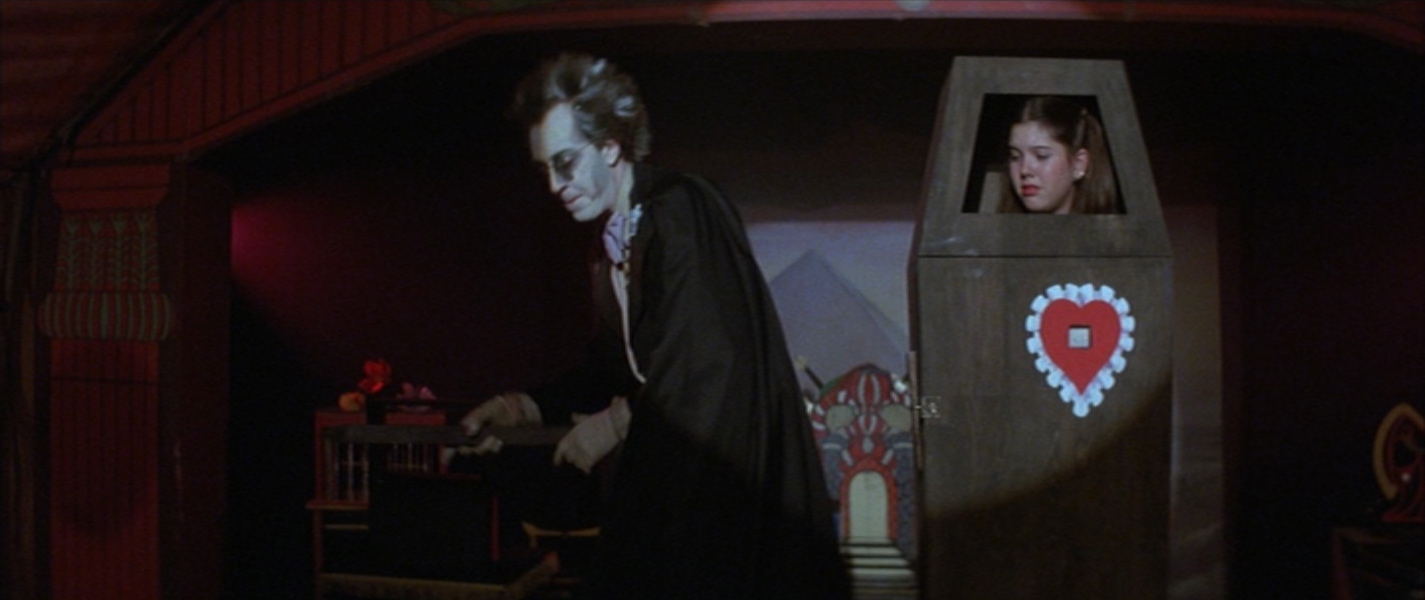
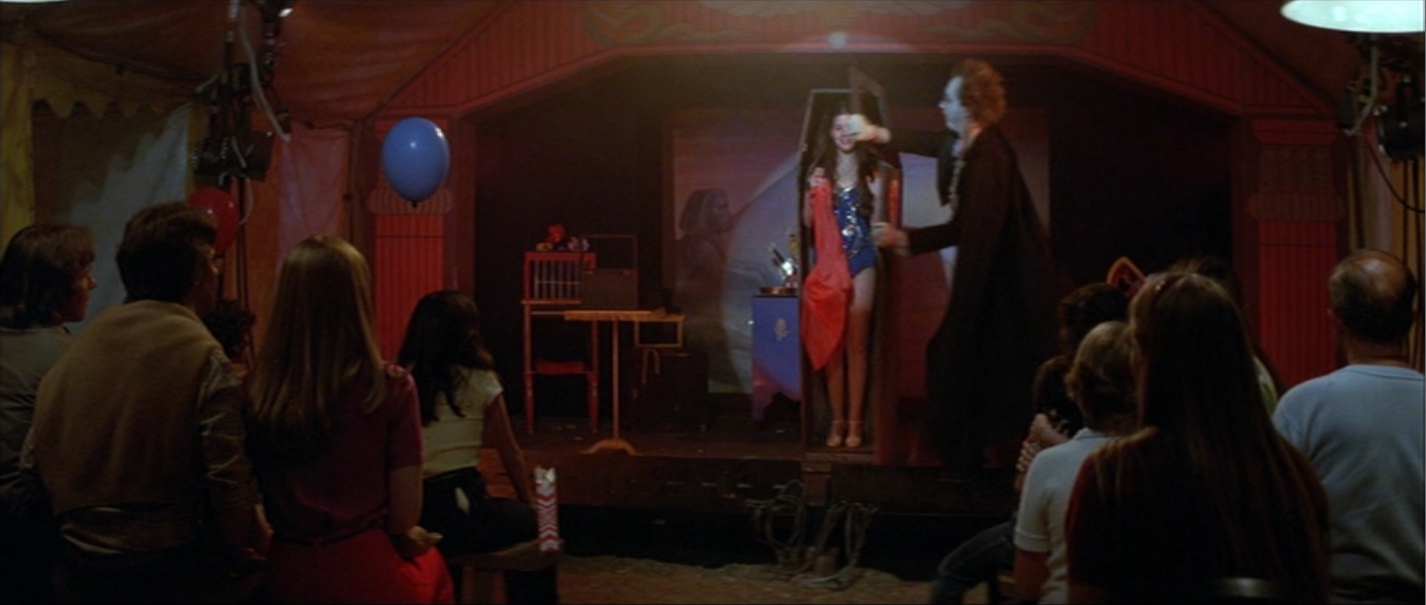
I was preparing to post the next chapter when I heard the news: William Finley, character actor extraordinaire, passed away yesterday. These pics are my three favorite roles of his, but he can also be seen in De Palma's The Fury and Sisters, as well as Hooper's Night Terrors.

The eyes have it. Take a bow, Marko.

Wednesday, November 17, 2010

Marko the Magnificent


"Now, I need a, uh..."


"...Volunteer, from the audience..."

William Finley is best known for the titular role in Brian De Palma's Phantom of the Paradise (1974) and his filmography includes other De Palma films like Sisters and The Fury. Tobe Hooper fans probably better know Finley for his hilariously deranged performance in Hooper's hilariously deranged Eaten Alive (1976) and another supporting role in Hooper's Night Terrors (1993)

The whole scene is essentially one long monologue by Willaim Finley encapsulating the most subtextual themes in The Funhouse at once.

By the way, Finley is credited in the film as "Marco" while in the last scene his tent clearly read "Marko," so forgive any alternations in this post. The character's name itself may be a reference to the 1965 film about Marco Polo, Marco the Magnificent, which featured hobbyist magician Orson Welles playing his tutor.


"A young lady..."


"Preferably attractive, uh..."


"Come on now, don't be bashful."

Live performance is a tricky balance between interaction and spectatorship, between performer and audience member. Standup comedians may speak to their audience conversationally, but there's no actual conversation. Carnival attractions must invite the illusion of interaction rather ruthlessly to draw and hold your attention, lest you keep walking. The illusion of interaction is utterly necessary and even taken for granted by the impetuous youth for whom a jaunt in a seedy carnival is a declaration of independence.

The carnival isn't a great place to try to assert yourself. The games are rigged, the roller coasters always follow the same track (unless you entertain thrilling possibility of breakdown) and magicians use "volunteers" from the audience more or less as puppets. Films humor a kind of personal involvement with their audience but their medium is further distanced than even the most jaded live performer - except perhaps horror and comedy films, the good ones of which tend to unexpectedly provoke.

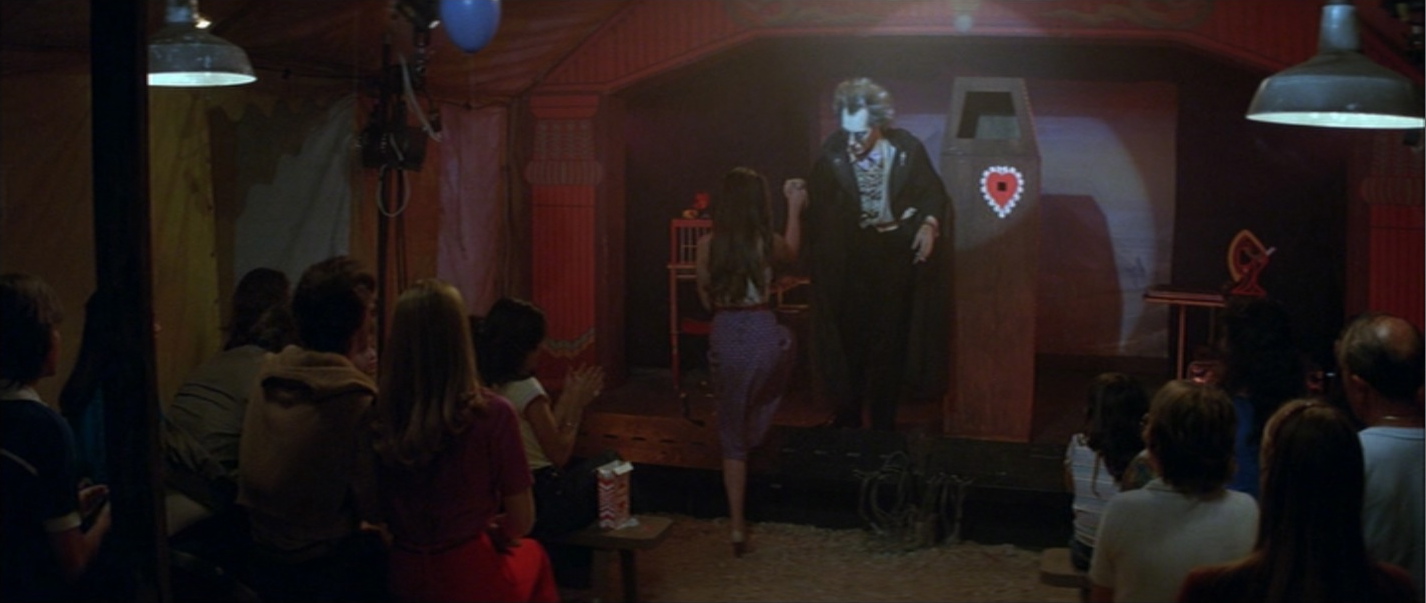
The staging of this scene is easily the most plainly theatrical in the film. Hooper just likes William Finley, and lets us watch him. There's no functional plot purpose, it's a stand alone piece with a beginning, middle and end. Compared to the other carnival attractions Amy & Co. check out, this is absolutely their least participatory. What this scene really does is seat the film's audience next to the carnival spectators, if seeing the same mutant farm animals hasn't done that to you already.


"You!"


"You!"


"C'mon!"

"No, I couldn't!"


"Oh, of course you could. C'mon up."

I love Liz's mix of relief and disappointment. Already the scene has strayed from screenplay formulas by not involving the central characters. A less special movie would have had Marko choose Liz or Amy. Hooper places the camera in the back row of the crowd, a highly mannered way of bringing the audience into the room.


"C'mon up."


"Let's give the little lady a...big hand."


"C'mon up here."


"You're not afraid, are you?"

"Yes."


"Smart girl."


"Please - "


"Step into the coffin."

Magic acts don't usually put volunteers in supposedly dangerous situations. Old routines involving the illusion of cheating death, like sawing a woman in half, are usually done with lovely assistants. Marko's casual dance across that line of trust between performer and audience in matters of life and death is the scene's second quiet violation. Nothing's a clearer symbol of death than a coffin, and how willingly the mark enters the carny's web as Amy and her friends will deliberately trap themselves inside the funhouse later.


"Go ahead."


"Right inside."


"I promise, you'll feel no pain."


"Get a regular job."


These close ups maintain the theatricality of the scene, too. No extreme angles or short lenses - this view of Marco and volunteer would be close to the focal point of someone sitting in the front row.


"Comfy?"

"No."


"Good." 


"Now, a little history."


"A little history!"


"(Laughing) Action, man!"

The spotlight brings us into the crowd bleachers just a little more as the spotlight forces our focus. There's only two reaction shots of Amy and friends left in the entire scene, amazingly. The camera now begins to track forward at an almost imperceptible pace, slowly drawing us in.


"Fifth century, Vlad the Fifth of Wallachia..." 


"Boooring!"

I love how blase Marko is about taking a nip from his flask in the middle of his act. That and the cigarette are the perfect seedy counterpoint to his otherwise professional demeanor. Drinking after mentioning Vlad's name seems like he's toasting to his memory.


"Known as Vlad the Impaler, to his friends..."


"Tortured 23,000 male and female prisoners..."


"In a device - "


" Not unlike this."


"We're fallin' asleep, Vlad!"


"Tiring of his name..."


"He decided to...change it."


"He selected..."


"His father's name - "


"Dracul"


"Meaning, 'devil.'"


"He added the letter 'A'..."


"And became..."


"Drac-u-la..."


"Literally, 'son of the devil.'"


"And so...legends are born."

Bruce F. Kawin's Film Quarterly essay The Funhouse & The Howling comments that Amy's little brother Joey learns how the horror genre is "connected in a meaningful way with genuine rape and murder in an unattractively perverse context." Tobe Hooper Appreciation Society author JR terms such iconography as horror "gentrified by yesteryear." The choice to make Marco the carnival magician a vampire with a vampiric set piece is a brilliant since Dracula is the sole contemporary to the film's heavily referenced monster Frankenstein, as evinced in Joey's room.

Marko's speech about Vlad the Impaler is the perfect reminder that even old dusty legend of Dracula used to have truly fearful resonance at one time, and the hecklers in the crowd are the voice of modern indifference.


"With that piece of history planted firmly in our mind,
I present without further ado..."


"...The Impaler."


"Notice if you will..."


"...That a hole has been..."


"...Cut in the front of this box..."


"...Right over the human..." 


"...Heart, within."


"I insert the stake..."


"...Gently..."


"Do you feel that, dear?"

"Yes!"

Sexy.


"Good."

"Find a new profession, bozo!"

Even the hecklers are mannered in this film.


"And now without further ado, I present..."


"...The Impaler."


Finley made that demonic face for the publicity still only. In the actual scene, with cigarette held between pursed lips, he looks more like a union carpenter.


"Oh my god!"


"Is there a doctor in the house?"


"Lights! Lights!"


"Ladies and gentlemen - "


"My charming daughter, Carmella."


"Thank you for your patronage - "


"Next show in two hours."


The end of this scene is a double whammy. First of all, the whole thing was a ruse. The girl was Marco's daughter and no one was going to be picked but her. Even better, the act barely qualifies as magic! Yeah, she changed her clothes inside the coffin, but that's not the point.

The switcheroo tricks the audience at home exactly the same as the fictive audience in the scene, which is brilliant. William Finley is so disarmingly phony at the start, and only after locking the girl in the coffin does he start to command our respect with his seriously intoned origin of Vlad / Dracula, the importance of which is emphasized by Hooper's camera incrementally creeping forward.

When "The Impaler" routine seems to go wrong, all that seeming incompetence comes rushing back. The blood spills from the girl's mouth. Then she's okay, and everything's fine! People love being scared so long as in the end, it's just a big joke. Marco's trick is particularly insidious in that unlike the straightforward artificial danger of a roller coaster (or funhouse) or even the is-it-or-isn't-it real sickliness of that freak tent fetus, he used the audience's cynicism against themselves. It's such a great screw-you to those hecklers, but also the entire audience, which expresses a real hostility to audiences in general. He knows they'll nonetheless accept and applaud being jerked around since they finally got the thrill they paid for.

The panic of simulated danger suddenly becoming real is of course what the film rubs in our faces later inside the funhouse, and this scene is a jolting taste of things to come.

Finally worth considering is the father-daughter relationship of Marko and Carmella. Like so many real life circus and carnival acts, both his and the Girl Tent barker's attraction (and the Funhouse barker, as we'll see) are a family act that uses the younger generation as little more than a prop. Is the relationship of Amy to her parents more or less healthy by comparison? Show your work, allowing for the fact that Marko drapes his cape protectively around his daughter as they exit.

Dean Koontz Extrapolation Korner:

(Amy is watching The Impaler)

   With a sickening, wet, tearing sound, the stake sank deep into the woman's chest.

   Jenny screamed, and blood gushed from her twisted mouth.


   The audience gasped. A couple of people cried out in horror.


   Jenny's head slumped to one side. Her tongue lolled. her eyes stared sightlessly over the heads of the people in the tent.


   Death miraculously transformed the face of the volunteer. The red hair turned to blond. The eyes changed from green to blue. The face was no longer that of Jenny, the woman who had walked onto the stage from the audience. It was now Liz Duncan's face. Every plane every hollow, every feature, every detail belonged to Liz. It wasn't just a trick of the light and shadows. It was Liz in that coffin. It was Liz who had been impaled. It was Liz who was dead, blood still oozing from between her ripe lips.

   Having trouble drawing her breath, my looked at the girl beside her and was amazed to see that her friend was still there. Liz was in the audience-yet somehow she was also on the stage, in the box, dead. Confused, disoriented, Amy said, "But it's you. It's you...up there."

   Liz-in-the-audience said, "What?"
   Liz-in-the-coffin stared into eternity and drooled blood.
   Liz-in-the-audience said, "Amy? Are you all right?"
   Liz is going to die, Amy thought. Soon. This is some sort of premonition...clairvoyance...whatever you call it. Could that be true? Could it? Will Liz be killed? Soon? Tonight?


...Wow, movie novelization authors hate scenes that are only about the main characters and story on an abstract level. So do producers, which is why it's miraculous this scene was included. Then again, it's miraculous the whole murder-less first half of this ostensible "slasher movie" got to be that way.

Also of note is that Koontz changes Marco's vampire getup to that of a devil - but that's because Koontz ignored the horror business deconstruction of The Funhouse in favor of Christian symbolism. That's all another post for another day.